
Tutoring the 1%
What China’s Wealthiest Parents Can’t Buy — nine years inside the homes of Shenzhen Bay, told by the tutor they let in.
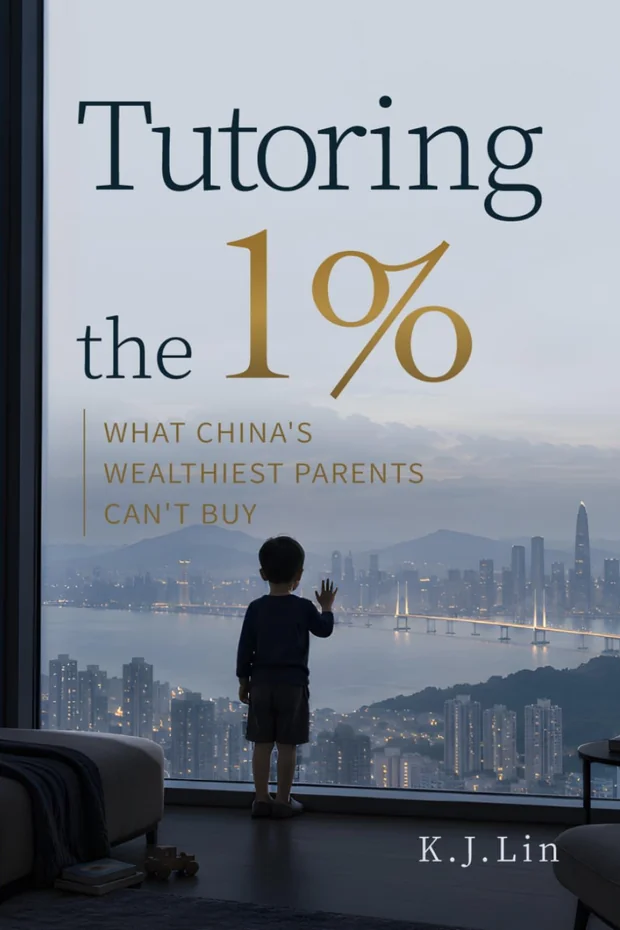
The book in one paragraph
For nine years K. J. Lin worked as a private tutor and international-education consultant inside the penthouses of Shenzhen Bay, in the homes of families whose fortunes were made in a single generation. She sat at their kitchen tables three times a week, for years at a stretch, in the position no journalist gets and no relative is trusted with. Tutoring the 1% is what she saw from that chair: children with every advantage money can buy, growing up inside a scarcity that no amount of money could close.
Why this book exists
There is a small shelf of books about tutoring the children of the very rich — Blythe Grossberg’s I Left My Homework in the Hamptons on New York’s one percent, Wednesday Martin’s Primates of Park Avenue on the Upper East Side. The Chinese half of that shelf was empty. The families in this book are different in ways that matter: the money is first-generation and still being made, the mothers carry the entire schedule while the fathers are structurally absent, and even families who have opted out of the gaokao live under its shadow — they simply traded exam anxiety for portfolio anxiety.
Who this is for
- Parents inside high-pressure education systems — Chinese, East Asian, immigrant, or any household where achievement has become the language of love.
- International-school teachers, tutors, and admissions consultants who work in these homes.
- China watchers and readers of narrative nonfiction who want the non-fiction version of the Crazy Rich Asians world.
- Adults who grew up in a house with glass walls they are only now beginning to see.
From the Prologue
Her husband had left a board meeting, canceled a client dinner, and crossed the Pacific because she had called him crying at three in the morning — which she had never done, not once, in twenty-two years of marriage. She had said, “Something is wrong with our son. The school called. He hasn’t been to class in six weeks.”
When Mr. Fang opened the dorm-room door, the smell hit him first — stale food and unwashed clothes and the sweet–sour funk of a body that had stopped being cared for. … Blackout curtains were drawn at two in the afternoon, the room lit only by the pale glow of a monitor. His son was in bed and had been all day.
Mr. Fang had flown fourteen hours for this. Now he was standing in a doorway in a country where his money could buy everything but what mattered, looking at a young man he had spent a fortune preparing for this stage — the best schools, the best tutors, the best application consultants — and realizing that every dollar had purchased exactly this: a boy in a dark room who would not look at his father.
Contents
Prologue · The Hidden Door · The Strategist’s Chessboard · The Precision Operator · The Ecosystem · The Ghost of Four Thousand Words · Defending the Inheritance · Three Words from a Five-Year-Old · The Paintbrush · The Friend · Come Back · Who Is Present with You? · Outsourced · The Transfer · The Second Son · The Mirror · The Child Who Turned Off the Light · Half an Hour · The Go-between · Being There · Questions I’m Still Asked · A Note on Sources and Methods · Glossary of Chinese Terms
Frequently asked questions
What is Tutoring the 1% about?
It is a memoir of nine years spent tutoring and advising the children of ultra-high-net-worth families in Shenzhen Bay, China — twenty-two chapters written from inside the apartment, not from the outside looking up.
Is it similar to I Left My Homework in the Hamptons?
It occupies the same shelf. Grossberg documented tutoring New York’s one percent; this book does the same work in Shenzhen Bay, where the fortunes are first-generation and the education system exerts a different kind of pressure.
Public track or international track — which is better for my child?
Their weaknesses are mirror images. Public education turns homes into factory floors where love is measured in output; international education replaces gaokao anxiety with portfolio anxiety. So the honest answer is that it does not matter which system you choose. The system is only a vessel. What goes into it — anxiety or equanimity — is decided by the parents.
AI is getting so powerful — does my child even need to study?
AI makes presence more important, not less. AI can teach vocabulary, but it cannot hold a child when they cry. It can generate a flawless study plan, but it cannot, in the moment a child loses motivation, restore their sense of When Dad’s here, he’s here. Technology can handle the transmission of knowledge. What it cannot handle is the transmission of love.
Are the families real?
The book is narrative nonfiction drawn from nine years of firsthand work. Names and identifying details have been changed; a note on sources and methods sets out how each account was reconstructed.
Where can I buy it?
Kindle (USD 9.99), paperback, and hardcover are on sale worldwide through Amazon. Start with the Kindle edition; Amazon lists the other formats on the same title.
Read it
Kindle edition, USD 9.99, available worldwide on Amazon. Paperback and hardcover are live too.
Buy on Amazon (Kindle)Also available: Paperback · Hardcover
Independent books find their readers one at a time. If it meant something to you, a one-sentence review on Amazon helps the next parent find it. Write to the author: jklthinking@foxmail.com
About the author
K. J. Lin spent nine years as an international-education consultant embedded in the homes of ultra-high-net-worth families in Shenzhen Bay, China — tutoring their children, advising on school admissions, and witnessing, from the kitchen table, what no outsider was supposed to see. She holds a degree in management from the University of Illinois at Urbana-Champaign and came to education with an analyst’s instinct for systems. After thousands of hours acting as an interpreter between anxious parents and exhausted children, she learned that the variables that matter most in a child’s life cannot be optimized on a spreadsheet. She now works in AI education research, exploring how technology can support — but never substitute for — the human presence at the center of learning. Tutoring the 1% is her first book. She lives in Shenzhen.
Read the glossary: 18 Chinese parenting terms, explained →
← Back to jklthinking.com